







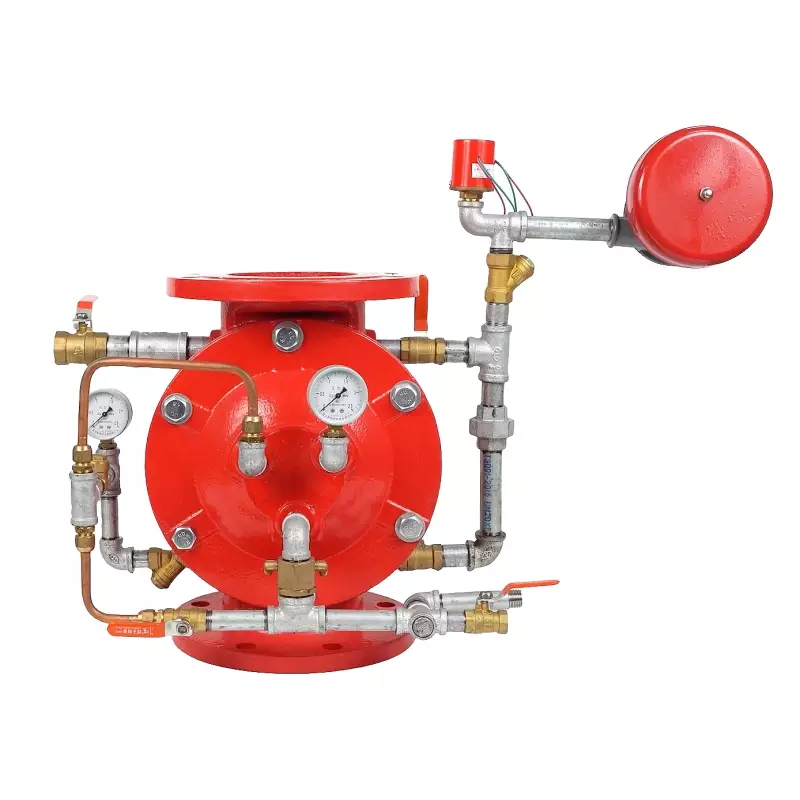
Diaphragm-Type Fire Alarm Deluge Valve
Diaphragm-Type Fire Alarm Deluge ValveProduct Overview
The Diaphragm Deluge Valve operates on the principle of a diaphragm check valve. When the pressure on both sides of the diaphragm is balanced, the diaphragm remains in the closed position. If the pressure in the water supply system exceeds that in the sprinkler system pipeline, the diaphragm automatically opens. As a one-way check valve, it can be combined with other components to form various deluge alarm and fire suppression systems. It is suitable for automatic water sprinkler fire suppression systems in places such as hospitals and shopping malls.
The fire alarm deluge valve serves as the core control device in deluge fire suppression systems. It is a valve automatically activated by electrical or hydraulic signals from a fire detection system. Once activated, water flows into the entire system network and is discharged simultaneously through all open sprinklers, covering the entire protected area like a heavy downpour. This enables rapid control and extinguishment of high-risk fires.
Diaphragm-Type Fire Alarm Deluge Valve Specifications
| Material | Body | Ductile Iron |
| Pipe | SS304 | |
| Ductile Iron | Brass | |
| Fire Alarm Bell | SS304 | |
| Size | DN100-DN125-DN150-DN200-DN250 | |
| Operating Pressure | 1.6Mpa | |
Diaphragm-Type Fire Alarm Deluge Valve Definition and Components
A Diaphragm-Type Fire Alarm Deluge Valve is a differential pressure valve that controls water flow in deluge fire suppression systems. It uses a flexible diaphragm to maintain a pressure differential that keeps the valve closed until a fire detection signal triggers its release.
Main Components:
- Valve Body - Main casting with inlet/outlet connections
- Diaphragm Assembly - Flexible rubber disc separating upper and lower chambers
- Upper Chamber (Control Chamber) - Maintains pressure to hold valve closed
- Lower Chamber (Supply Chamber) - Connected to water supply
- Solenoid Pilot Valve - Electrically operated release mechanism
- Manual Release Device - Mechanical override for emergency operation
- Pressure Switch - Electrical signaling device for alarm activation
- Water Motor Gong - Hydraulic audible alarm
- Strainer - Protects small orifices from debris
- Test & Drain Valves - For system testing and maintenance
- Pressure Gauges - Monitor supply and control pressures
Role, Characteristics, and Application Scenarios of Diaphragm-Type Fire Alarm Deluge Valve in Pipelines
Fire Sprinkler Alarm Check Valve Primary Functions:
- Flow Control: Maintains water in "ready" position, prevents flow until activated
- Rapid Response: Opens completely within seconds of fire detection
- Dual Alarm: Activates both electrical and audible alarms
- System Supervision: Monitors water supply integrity
Operational Features:
- Differential Pressure Design: Upper chamber pressure holds valve closed
- Dry System: Downstream piping remains dry until activation
- Multiple Activation: Electric, hydraulic, pneumatic, or manual release
- Automatic Alarm: Water flow triggers pressure switch and water motor gong
- Field Reset Required: Manual resetting after operation
Application Scenarios:
- Industrial High-Risk Areas: Chemical plants, paint shops, solvent storage
- Power Facilities: Transformers, turbine halls, boiler rooms
- Transportation: Aircraft hangars, vehicle tunnels, ship engine rooms
- Special Hazards: Flammable liquid processing, ammunition storage
- Large Spaces: Atriums, exhibition halls with special suppression needs
Diaphragm-Type Fire Alarm Deluge Valve Standards: Materials, Design, and Connections
Fire Valves Material Standards:
- Body/Bonnet: Ductile Iron (ASTM A536), Cast Iron (ASTM A126)
- Diaphragm: EPDM, NBR, or Viton per fluid compatibility
- Internal Trim: Bronze (ASTM B584), Stainless Steel 316
- Springs: Stainless Steel 302/316
- Fasteners: Zinc-plated steel or stainless steel
Design Standards:
- NFPA 15: Standard for Water Spray Fixed Systems
- FM Global: Approval Standard 1010/1011
- UL/FM Listed: For North American markets
- EN 12259-4: European standard for water mist systems
- GB 5135.5: Chinese national standard
Connection Standards:
- Flanged: ANSI B16.1 Class 125/250, EN 1092-2 PN16/PN25
- Threaded: NPT (ANSI B1.20.1) or BSPT (ISO 7-1)
- Typical Sizes: 3" to 8" (DN80 to DN200)
- Alarm Connections: Usually 1" NPT or 3/4" NPT
How to Select Diaphragm-Type Fire Alarm Deluge Valve
Purchasing Checklist:
Specification Development:
- Determine required size based on hydraulic calculations
- Specify pressure rating (175 PSI standard, 250 PSI optional)
- Choose activation method (single/dual solenoid, hydraulic, etc.)
- Identify required certifications (UL, FM, LPCB, VdS)
- Note special requirements (corrosion resistance, seismic rating)
Supplier Evaluation:
- Verify manufacturing certifications (ISO 9001, UL listing)
- Check project references in similar applications
- Evaluate technical support capabilities
- Review warranty terms and spare parts availability
Documentation Requirements:
- UL/FM listing certificates
- Factory test reports for each valve
- Material certificates (mill test reports)
- Installation and maintenance manuals
- Submittal drawings and technical data sheets
Commercial Terms:
- Lead Time: 8-12 weeks for standard configurations
- Payment: 30% deposit, 70% before shipment
- Warranty: Minimum 2 years from shipment
- Incoterms: FOB factory or CIF destination port
- MOQ: Typically 1 unit for standard sizes
Pre-Shipment Inspection for Export Diaphragm-Type Fire Alarm Deluge Valve and Key Considerations
Inspection Protocol:
| Check Area | Procedure | Acceptance Criteria |
| Visual Inspection | Examine all surfaces | No cracks, porosity, damage |
| Dimensional Check | Measure flange dimensions | Per ANSI/EN standards |
| Material Verification | Check material certs | Match PO specifications |
| Pressure Testing | Hydrostatic test @ 1.5脳WP | No leakage for 2 minutes |
| Functional Test | Activate via all methods | Smooth operation, full opening |
| Alarm Test | Simulate water flow | Gong >70dB, pressure switch activates |
| Coating Inspection | Thickness measurement | 8-12 mils DFT, no holidays |
Critical Export Precautions:
- Post-Test Drying: Complete disassembly, drying with compressed air, reassembly with desiccant packs
- Corrosion Protection: VCI paper wrapping, temporary corrosion inhibitor on machined surfaces
Component Protection:
- Solenoid: Individual shock-resistant packaging
- Diaphragm: Protected from ozone and UV exposure
- Pressure gauges: Zeroed and sealed
- Packaging: ISPM15 compliant crates, proper bracing, "Keep Dry" markings
- Documentation: Complete set including certificates of compliance, test reports, manuals
System Operation Summary:
This installation demonstrates a dual-reactor protection system in a chemical plant. Each reactor has its own dedicated deluge valve and distribution network. The diaphragm-type valve provides:
- Instantaneous Response: When reactor temperature exceeds safe limits, the system activates within seconds
- Complete Coverage: Water spray nozzles positioned to completely envelop each reactor
- Contained Operation: Drainage system prevents chemical/water runoff
- Dual Alarm: Both audible and visual alarms alert plant personnel
- Manual Override: Operators can activate system manually if detectors fail
The system remains in "ready" state with the diaphragm valve closed and control chamber pressurized. Upon fire detection, the pressure differential is released, allowing the diaphragm to lift and water to flood the protected area simultaneously through all open nozzles.