







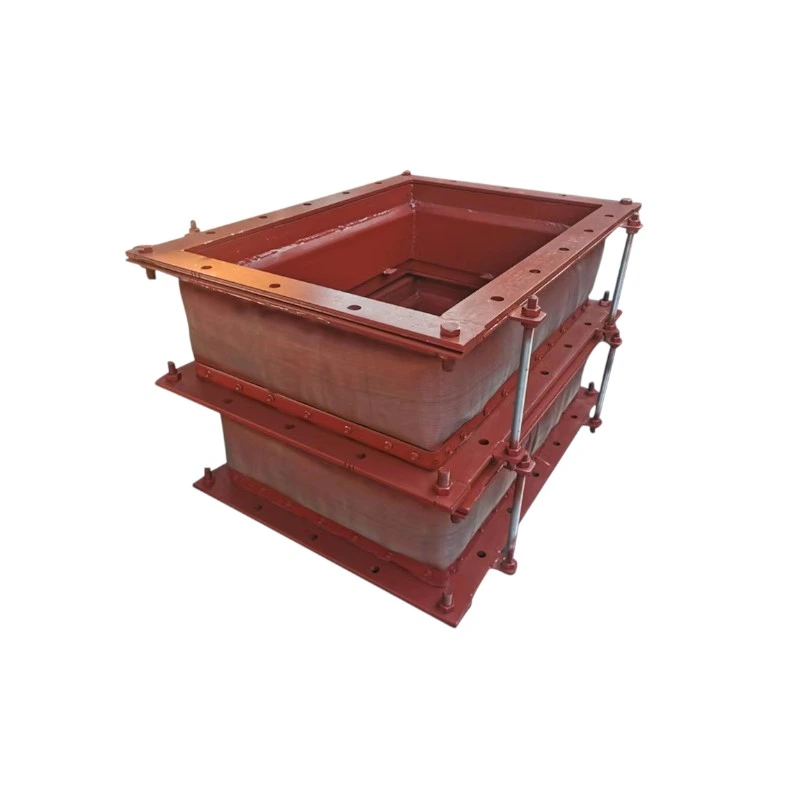
Rectangular Non-Metallic Expansion Joint
A Non-Metallic Expansion Joint is a highly flexible, multi-layered connector engineered specifically for low-pressure rectangular ductwork systems. It efficiently compensates for multidirectional thermal growth, structural vibration, and mechanical misalignment while containing system pressure. Unlike rigid metallic alternatives, this specialized assembly is constructed from advanced composite fabrics and high-performance elastomers, offering negligible spring rates, excellent noise dampening, and superior corrosion resistance in aggressive industrial atmospheres.
Main Parts: Flexible Bellows (The Core) and Structural Components
The core performance of a non-metallic compensator relies on its multi-layered thermodynamic skin, where each material ply serves a distinct structural function within the assembly:
-
-
Flexible Bellows (Multi-Layered Fabric Construction):
-
Inner Liner: The fluid-contacting ply utilizes advanced elastomeric membranes or films, such as fluororubber, silicone-coated fabric, or PTFE, to provide absolute chemical sealing and resistance against aggressive gas condensates.
-
Architecture Fabric: The structural backbone layer incorporates high-strength woven matrices, including aramid fiber, fiberglass cloth, or polyester yarns, to withstand system design pressures and tear forces.
-
Insulation Layer (Optional): An interior core utilizing high-density aluminum silicate fiber or glass wool to insulate the outer plies from extreme process heat.
-
External Cover: The outermost shield, typically composed of neoprene or Hypalon-coated fabrics, engineered to resist UV degradation, ambient moisture, and external mechanical abrasion.
-
-
Frame (Reinforcement): A rectangular structural frame, typically fabricated from heavy-duty steel (often galvanized or stainless), to which the bellows are mechanically attached. It provides mounting flanges and maintains the required shape under vacuum conditions.
-
Flanges / Connection Legs: Integrated with the steel frame for direct bolting to the adjacent ductwork sections, capable of being drilled to match specified project bolt patterns.
-
Control Rods / Tie Rods (Optional but common): External hardware that limits axial compression or extension, absorbs pressure thrust, and prevents over-extension without restraining lateral movement unless configured as a tied universal joint.
-
Internal Liner / Flow Media (Optional): A removable PTFE or metallic baffle to protect the flexible fabric bellows from highly abrasive or high-temperature direct flow streams.
-
External Covers / Shields (Optional): Metal or composite guards engineered to protect the exterior fabric bellows from mechanical damage during operation or maintenance.
-
Role, Characteristics, and Application Scenarios of Rectangular Non-Metallic Expansion Joint in Pipelines
Ductwork Engineering Water Supply Valve Functions:
-
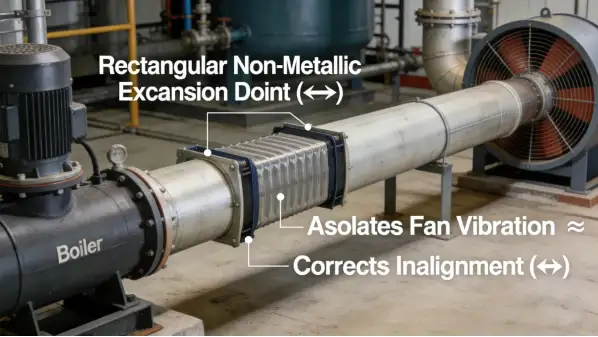
Movement Absorption: Compensates for intense thermal expansion, contraction, structural vibration, and equipment settlement in rectangular duct systems.
-
Misalignment Correction: Accommodates initial axial, lateral, and angular installation offsets between misaligned duct sections.
-
Noise & Vibration Dampening: The flexible fabric composite significantly reduces structure-borne noise and isolates vibration transmission from heavy fans and blowers.
-
Pressure Containment: Designed to fully contain positive system pressure or negative vacuum conditions within its calculated rating.
Operational Features:
-
Low Spring Rate: Requires significantly less force to compress or extend than metallic joints, drastically reducing stress on anchors and structural supports.
-
Multi-Directional Movement: Captures simultaneous movements across multiple planes (axial, lateral, and angular) within a single compact installation length.
-
Wide Temperature Range: Handles continuous operational environments from -40°F to +450°F (-40°C to +232°C), easily extendable up to 1000°C with advanced special thermal insulation materials.
-
Chemical & Corrosion Resistance: Inherently resistant to many corrosive atmospheres and acidic gas condensates where traditional metals would suffer rapid failure.
-
Lightweight Design: Easier to handle, rig, and install than heavy metallic counterparts, lowering overall field installation costs.
Primary Application Scenarios:
-
-
Power Plant Flue Gas Ductwork (SCR and FGD Systems): The most critical and common application, handling large thermal movements and highly corrosive gases.
-
Industrial Process Gas Ducts: Deployed extensively in cement plants, steel mills, chemical processing facilities, and pulp and paper mills.
-
HVAC Systems for Large Facilities: Connects heavy-duty industrial fans, chillers, and large air ducts to isolate operational vibration.
-
Marine Exhaust Systems: Compensates for engine movement and extreme thermal growth in large vessel exhaust piping.
-
Turbine Inlet and Exhaust Connections: Installed directly within gas and steam turbine ventilation loops.
-
Rectangular Non-Metallic Expansion Joint Standards: Materials, Design, and Connections
Material Standards:
Fabric Materials:
- Fibers: Aramid (e.g., Nomex®, Kevlar® per DuPont specs), Fiberglass (ASTM D578), Polyester (ASTM D885).
- Coatings: Silicone Rubber (ASTM D771), PTFE (Film or Impregnated, per ASTM D5748), EPDM, Chloroprene (Neoprene, per ASTM D2000).
- Frame & Hardware: Steel (ASTM A36), Galvanized per ASTM A123, Stainless Steel (ASTM A240, Grade 304/316).
- Bolts/Nuts: ASTM A193/A194 or stainless equivalent.
Design & Performance Standards:
Primary Standard: EJMA (Expansion Joint Manufacturers Association) Standards - The global authority for design, manufacture, and testing of expansion joints, covering both metallic and non-metallic.
Application-Specific:
- Power/Flue Gas: Often designed to client/engineering specifications (e.g., from Bechtel, Fluor, etc.) referencing EJMA.
- HVAC: SMACNA (Sheet Metal and Air Conditioning Contractors' National Association) guidelines for ductwork.
- Pressure & Vacuum Rating: Designed per EJMA calculations. Must be clearly stamped/marked.
- Movement Capacity: Rated for axial, lateral, and angular movements per EJMA.
Connection Standards:
- Flange Drilling: Typically follows ANSI/ASME B16.1 (Cast Iron) or B16.5 drill patterns for the given rectangular dimensions, or as per detailed customer drawings.
- Face-to-Face Dimensions: Custom per order, but constrained by minimum installable length for required movement.
- Gasketing: Supplier usually provides a recommended gasket type (e.g., ceramic fiber, graphite) based on service.
How to Select Rectangular Non-Metallic Expansion Joint
Define Comprehensive Specifications:
- Duct Dimensions (ID): Clear Inside Width & Height.
- Design Conditions: Operating & Maximum Temperature, Design Pressure (Positive & Vacuum).
- Required Movements: Quantify all movements (Axial Compression/Extension, Lateral, Angular) from thermal and mechanical analysis.
- Media & Environment: Exact gas composition, presence of abrasives/catalysts, and external environment.
- Connection Details: Flange thickness, bolt size/quantity/hole pattern, face-to-face length.
- Special Features: Need for internal liner, external covers, purge connections, control rods, etc.
Supplier Qualification:
- Seek fire protection system supplier with EJMA membership and proven experience in your specific industry (e.g., power generation).
- Request project references and case studies.
- Review their engineering and quality manuals.
Technical & Commercial Evaluation:
- Require detailed General Arrangement (GA) drawings and material breakdown list for approval before manufacture.
- Obtain design calculations (based on EJMA) for review, especially for critical applications
- Compare warranties, lead times, and scope of supply (e.g., are gaskets and bolts included?).
Logistics Planning:
Due to large size, shipping (especially sea freight) requires careful planning. Confirm packing method (crated or palletized) and dimensions/weight.
Pre-Shipment Inspection for Export Rectangular Non-Metallic Expansion Joint and Key Considerations
Inspection Protocol:
Documentation Check:
- Approved GA drawings vs. as-built.
- Material Certificates (MTCs) for fabrics, coatings, frame steel, bolts.
- Weld Procedures & Welder Qualifications (for frame).
- Certified Design Calculations (a critical deliverable).
Visual & Dimensional Inspection:
- Verify overall dimensions, flange flatness, and bolt hole alignment.
- Inspect fabric bellows for uniformity, contamination, or surface defects.
- Check quality of seams and bonds in the fabric.
- Verify all welds on the frame are clean and continuous.
- Ensure proper installation and function of any control rods/latches.
- Confirm nameplate data (Size, Pressure, Temp, Movements) matches PO.
Functional & Pressure Testing:
- Leak Test (Most Common): A pressure hold test (air or water) at 1.5x design pressure per EJMA. Soap solution applied to all seams and connections.
- Vacuum Test: For joints designed for vacuum service, tested to the specified vacuum level.
- Movement Setup Verification (Critical): Inspectors must verify the joint is preset correctly (if required by design) for installation at ambient temperature. This is often marked clearly on the frame. Incorrect preset is a common cause of field failure.
- Proof of Movement Test (Optional/Rare): Full-scale movement testing is seldom done on large rectangular joints due to facility constraints but may be simulated or verified by inspection of the restraint system setup.
Packaging & Preservation:
- Fabric bellows must be protected from moisture, UV, and physical damage. Shipped with protective plastic/vinyl covers.
- Flange faces painted with protectant and covered with plywood/plastic.
- Internal cavity should be blocked or braced to prevent collapse during shipping.
- Securely mounted in a rigid, weather-protected crate. Large joints may require custom crating.
Key Precautions:
- Preservation is Paramount: Non-metallic fabrics are sensitive to moisture, oil, and sunlight. Packaging must ensure they arrive on site in factory-fresh condition.
- Preset Verification: The single most important check for the end-user. Confirm the marked installation length/cold setting matches your project's installation temperature requirements from the piping stress analysis.
- Third-Party Inspection (TPI): Highly recommended for large, critical joints. The TPI inspector should witness the final pressure test and preset verification.
- Spare Materials: Purchase a kit of the exact bellows fabric material for field repairs.
- Handling Instructions: Ensure clear handling/installation instructions are packed with the joint to prevent field damage during lifting (never lift by the fabric!).
Rectangular Non-Metallic Expansion Joint Main Dimensions (mm)
Basic Nominal Size:
Main Technical Specifications:
Main Materials: