







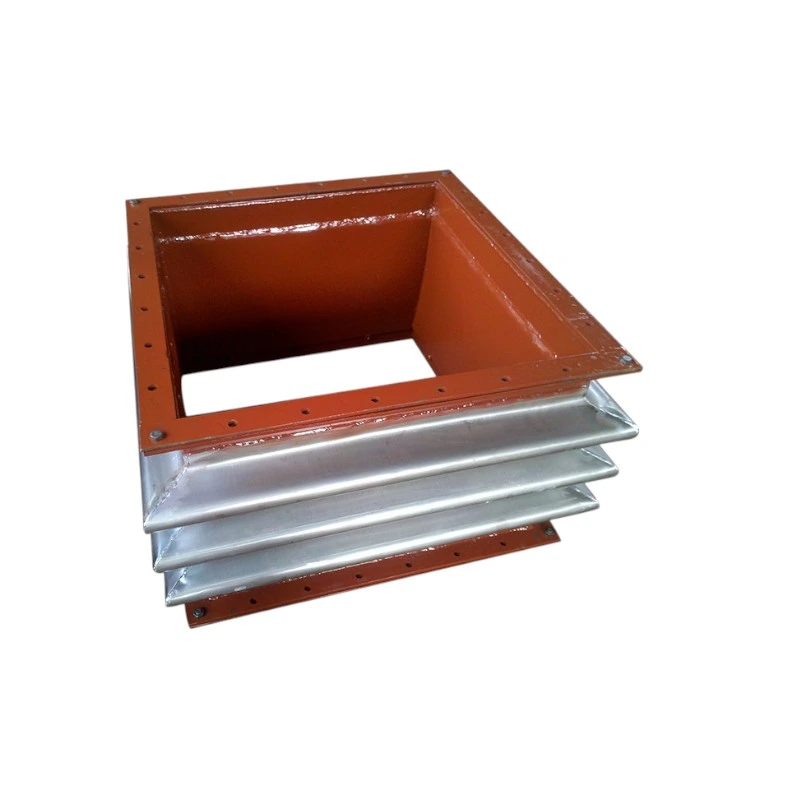
Rectangular Metal Corrugated Expansion Joint
1. Definition and Structural Components
A Rectangular Metal Corrugated Expansion Joint is a highly engineered flexible connector designed for rectangular ductwork and low-pressure piping systems. It is primarily installed to accommodate thermal expansion, absorb mechanical vibration, and reduce structural stress on connected equipment.
Main Components
-
Bellows (Corrugated Element): The core flexible component, engineered from premium metal sheets to allow multi-directional movement.
-
End Connections: Heavy-duty welded ends or flanges (matched to duct dimensions) for seamless system integration.
-
Internal Liner (Flow Liner): An optional structural shield that reduces fluid turbulence, minimizes erosion, and prevents resonant vibration caused by high-velocity media.
-
External Cover: A protective metal shield safeguarding the bellows against external mechanical damage and environmental corrosion.
-
Tie Rods / Limit Rods: Hardware assemblies designed to control the movement range and absorb pressure thrust forces.
-
Reinforcement Beams: External structural steel welded into the convolutions to prevent bellows deformation under high-pressure conditions, particularly critical for large span dimensions.
-
Gusset Plates: Heavy-duty corner reinforcement plates designed to distribute stress uniformly at the rectangular corner joints.
2. Functions, Key Characteristics, and Applications
Primary Non-Metallic Expansion Joint Functions in Piping & Ducting Systems
-
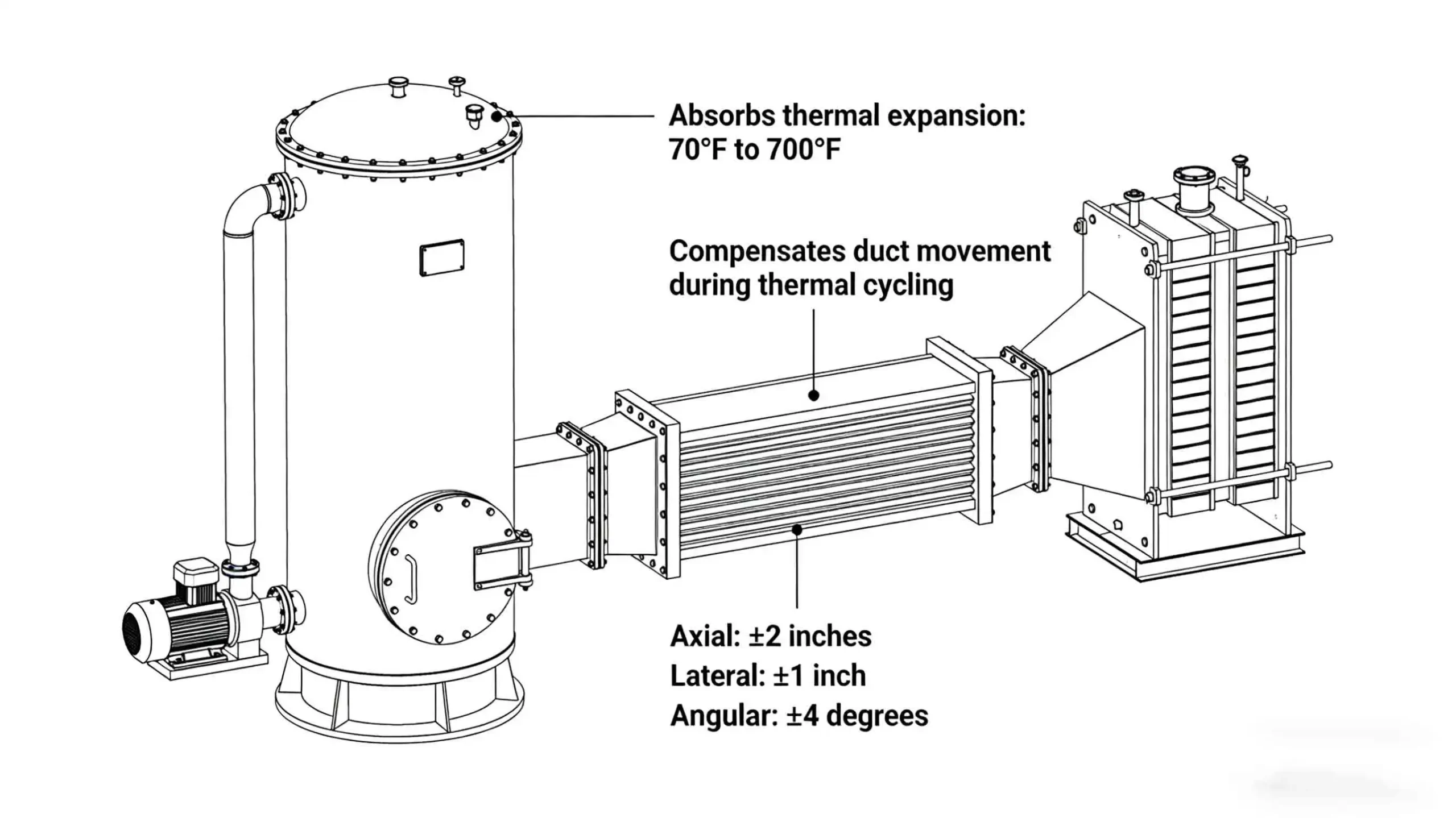
Thermal Displacement Compensation: Efficiently absorbs axial compression/extension, lateral offset, and angular rotation caused by temperature fluctuations.
-
Misalignment Correction: Compensates for minor installation tolerances and structural settling.
-
Vibration and Noise Isolation: Damps high-frequency mechanical vibrations from fans, blowers, and engines, significantly reducing acoustic transmission.
-
Stress Relief: Protects costly downstream equipment (such as boilers, turbines, and dust collectors) from excessive nozzle loads.
Key Operational Features
-
Multi-Directional Flexibility: Simultaneously handles multi-axis movements within a compact face-to-face length.
-
High Temperature & Pressure Resistance: Engineered to withstand extreme operating conditions, typically ranging from -196°C to 1000°C (-320°F to 1832°F).
-
Custom Geometric Configurations: Available in multiple corner configurations, including round corner, single-mitre corner, and double-mitre corner to fit specific flow profiles.
Typical Application Scenarios
-
Power Generation: Fossil fuel power plant duct systems, flue gas desulfurization (FGD) systems, and SCR systems.
-
HVAC Systems: Large-scale commercial and industrial ventilation air ducts.
-
Industrial Exhaust & Ventilation: Steel mills, cement kilns, and smelting plant exhaust ducting.
-
Petrochemical & Chemical: Process gas ducting and low-pressure chemical vapors.
-
Marine & Heavy Machinery: Large marine diesel engine exhaust systems and generator test facilities.
3. Design Standards, Material Selection, and Connections
Engineering & Compliance Standards
-
EJMA (Expansion Joint Manufacturers Association): The globally recognized authoritative standard for bellows calculation and life-cycle design.
-
ASME Section VIII, Division 1 & ASME B31.3: Governs pressure vessel calculations and process piping integration compliance.
-
GB/T 12777 & JB/T 6171: National Chinese standards for metal bellows expansion joints.
Material Selection Matrix
| Material Grade | Technical Characteristics | Typical Application Scenarios |
| SS304 / SS304L | General-purpose, excellent cost-efficiency, reliable oxidation resistance. | Standard HVAC, clean air ventilation, and low-temperature flue gas. |
| SS316 / SS316L | Superior pitting corrosion resistance due to Molybdenum content. | Chemical processing, marine exhausts, and mild chloride environments. |
| SS321 | Titanium-stabilized alloy, excellent intergranular corrosion resistance. | High-temperature exhaust ducts, gas turbine piping (up to 600°C). |
| SS310S | Ultra-high temperature oxidation resistance. | Furnace ducts, cement kilns, and extreme thermal applications (up to 1000°C). |
| Inconel 625 | Exceptional fatigue strength, resists chloride-ion stress corrosion cracking. | Petrochemical FCCU units, severe acid gas, and high-pressure/high-temp ducts. |
| Hastelloy C-276 | Outstanding resistance to strong reducing and oxidizing corrosive media. | Severe chemical flue gas scrubbing, wet desulfurization systems. |
Connection Specifications
-
Flanged Connection: Built to standard industrial specifications (ANSI/ASME B16.5, B16.47, EN 1092) or entirely customized to match existing rectangular duct flanges.
-
Welded End Connection: Beveled ends designed for direct welding into the ductwork, ensuring zero-leakage performance.
4. Technical Specifications & Performance Ranges
| Technical Parameter | Typical Range / Capabilities |
|---|---|
| Nominal Size (W × H) | up to 5000×5000 mm (custom oversized dimensions available) |
| Axial Compensation | to +200 mm |
| Lateral Compensation | to ±100 mm |
| Angular Rotation | to ±8∘ |
| Working Pressure Range | to PN 0.4 MPa (reinforced configurations handle higher pressures) |
| Working Temperature | −196∘C to 650∘C(up to 1000∘C with internal refractory lining and SS310S/Inconel) |
| Applicable Medium | Flue gas, hot air, steam, dusty gases, exhaust fumes, and corrosive vapors |
5. Technical Selection Guide for Procurement
To receive an accurate engineering proposal and quotation, please clarify the following parameters during inquiry:
1. Operating Parameters
-
Temperature Profile: Design temperature, maximum operating temperature, and minimum ambient installation temperature.
-
Pressure Profile: Maximum system design pressure and potential vacuum/negative pressure values.
-
Flow Media: Type of gas/fluid, particulate concentration (for abrasive dust), and chemical composition (to prevent chemical attack).
2.Water Supply Valve Displacement Demands
-
Calculated thermal expansion in Axial (compression/extension), Lateral (parallel offset), and Angular planes.
-
Anticipated cyclic frequency (fatigue design life requirement, e.g., 1000, 5000, or 10000 cycles).
3. Dimensional & Layout Constraints
-
Exact internal or external duct dimensions (W × H).
-
Face-to-face (FTO) installation length limits.
-
Duct wall thickness and material grade of the mating ductwork.
4. Optional Accessories
-
Is an internal flow liner required? (Highly recommended if velocity exceeds 6 m/s for gas).
-
Are external protective covers or shipping bars required?
6. Pre-Shipment Inspection (PSI) & Export Packing Standards
To guarantee that components arrive on-site in pristine mechanical condition, our strict quality control framework involves the following steps:
Technical Inspection Criteria
-
Dimensional Tolerances: Absolute verification of face-to-face length, flange flatness, and bolt-hole alignment (standard tolerance maintained within±3 mm or ±1/8′′).
-
Welding Quality Assurance: Non-Destructive Examination (NDE) including Liquid Penetrant Testing (PT) and Radiographic Testing (RT) on critical corner welds to ensure zero porosity and undercut defects.
-
Leakage and Pressure Testing: Soap bubble testing or hydrostatic pressure testing conducted at1.5× design pressure when structural design permits.
-
Traceability Documentation: Comprehensive QA dossier compiled for the client, including Material Test Reports (MTRs), EJMA calculation data sheets, NDE reports, and pressure test certificates.
Heavy-Duty Export Packaging Requirements
CRITICAL HANDLING PRECAUTION: Metal bellows are precision flexible elements highly vulnerable to torsion and impact. Shipping bars/spacers must remain securely painted and locked during transit and installation. They should only be removed after the expansion joint is completely welded or bolted into the rigid piping system.
-
Environmental Protection: The entire assembly is wrapped in heavy-duty weatherproof plastic or vacuum-sealed VCI anti-rust film.
-
Mechanical Structural Bracing: Rigid internal timber or steel bracing is inserted inside the duct to prevent any lateral shifting or collapsing of the bellows during transit.
-
Flange Protection: Mating faces are covered with thick plywood or heavy rubber gaskets to prevent scratches or deformation on sealing surfaces.
-
Crating Specification: Packed into ISPM-15 compliant, IPPC-certified fumigated wooden cases or reinforced steel frames, featuring clearly marked center-of-gravity, lifting points, and standard international shipping symbols ("Fragile", "This Side Up").