







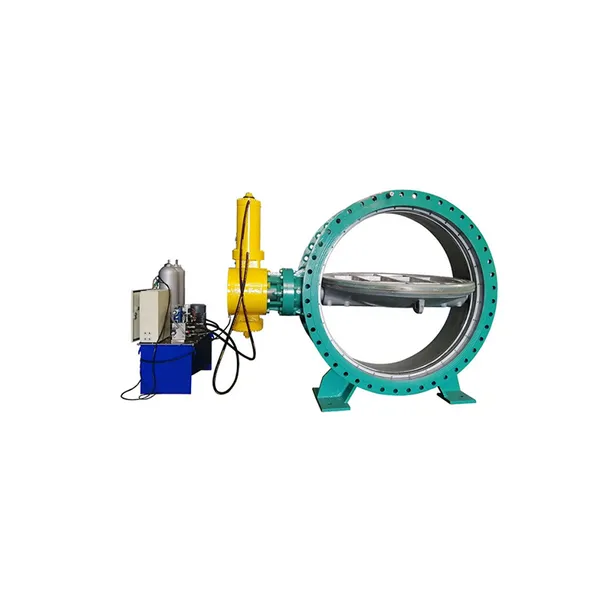

Accumulator Type Hydraulic Butterfly Valve HD743
Accumulator Type Hydraulic Butterfly Valve Definition and Components
What is the HD743 and its Main Parts?
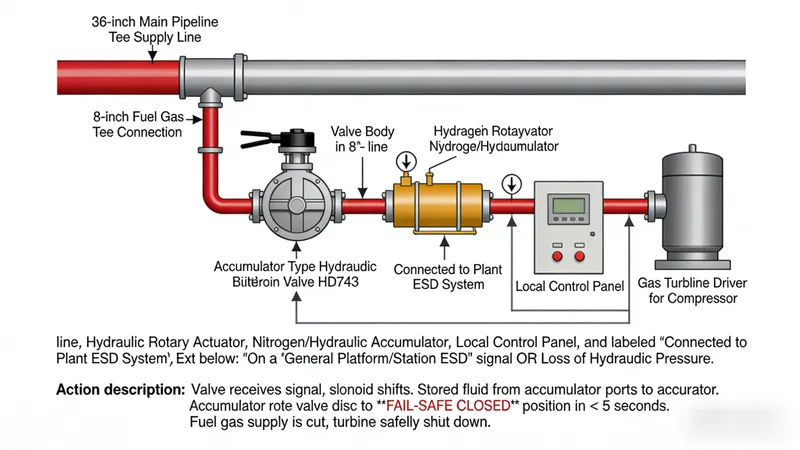
En Accumulator Type Hydraulic Butterfly Valve HD743 is an integrated, self-contained fail-safe valve assembly. It combines a butterfly valve with a hydraulic actuator powered by a local, pre-charged accumulator system. Its primary function is to close (or open) automatically upon loss of system pressure or an emergency signal, using stored hydraulic energy.
Accumulator Type Hydraulic Butterfly Valve Main Components:
- Butterfly Valve Body: The flow control element, typically a high-performance double-offset or triple-offset design for tight shut-off (API 609). Includes disc, seat, and stem.
- Hydraulic Rotary Actuator: A compact, robust hydraulic motor (vane or piston type) mounted directly to the valve stem. It converts hydraulic pressure into rotary torque to operate the valve.
- Hydraulic Accumulator(s): A pressure vessel(s) pre-charged with nitrogen and filled with hydraulic fluid. This is the "energy storage bank" that provides the force for the fail-safe operation without external power.
- Local Hydraulic Power Unit (Mini-HPU): A small, integrated unit with a hand pump and/or an electric/pneumatic pump to charge the system and reset the valve after a trip.
- Solenoid Valve & Control Block: The pilot valve that, upon an electrical signal, directs stored hydraulic fluid from the accumulator to the actuator to trigger the fail-safe action (close/open).
- Anulación manual: A hand lever or hydraulic hand pump for local manual operation.
- Position Indicator & Feedback Switches: Local visual indication (flag) and limit switches to signal valve position (open/closed) to the control room.
- Armario de control: Houses the solenoid, terminals, and sometimes a small PLC for local logic, often rated for hazardous areas.
Role, Characteristics, and Application Scenarios of Accumulator Type Hydraulic Butterfly Valve in Pipelines
Funciones, características operativas y escenarios de uso
Funciones en pipelines:
- Parada de emergencia (ESD): Rapidly isolates a section. Commonly used for smaller line sizes or where space is constrained.
- Throttling & On/Off Control: Can be used for flow regulation under normal hydraulic control and then slam-shut on emergency.
- Función de válvula de retención: Can be configured to close automatically upon flow reversal or excessive flow rate.
- Pressure Relief/Overpressure Protection: Configured to open or close to protect a downstream low-pressure section.
Características operativas:
- Compact & Integrated Design: All components (valve, actuator, accumulator) are often skid-mounted or tightly packaged, reducing footprint and field assembly.
- Self-Contained Energy Source: The accumulator holds enough energy for multiple cycles (typically 2-3 full cycles) without external power.
- Fast Response Time: Hydraulic actuation allows for very rapid closure (seconds), minimizing released volume in a rupture scenario.
- Spring-Return Alternative: While some systems use a spring, the accumulator type allows for higher torque, more cycles, and adjustable closing speed via orifices.
- Maintains Position on Power Loss: The valve will hold its last position until a specific trip signal is received or hydraulic pressure decays.
Escenarios de uso típicos
- Pipeline Take-off Lines: At junctions to storage tanks, off-take stations, or compressor stations.
- Fuel Gas Skids: To isolate the fuel gas supply to turbines or compressors on ESD.
- Pressure Reduction & Metering Stations: As the emergency isolation valve on inlet or outlet headers.
- Tank Inlet/Outlet Valves: For emergency isolation of storage tanks.
- Subsea/Offshore Platforms: Where reliability and compactness are crucial. Often used on utility lines (chemical injection, etc.).
Accumulator Type Hydraulic Butterfly Valve Standards: Materials, Design, and Connections
Material, diseño y normas de conexión
Normas materiales:
- Valve Body & Disc: ASTM A216 WCB (carbon steel), A351 CF8M (316 stainless), or duplex stainless steel (A995 Gr. 5A) for corrosive service. Internals often 17-4PH or 316 SS.
- Asientos: Resilient (e.g., EPDM, Viton) for low-temp, or metal (Stellite-faced) for high-temp/fire-safe designs (API 607/API 6FA).
- Accumulator Bladder/Diaphragm: Nitrile or HNBR compatible with hydraulic fluid and nitrogen.
- Hydraulic Tubing: Stainless steel (ASTM A269) for clean, corrosion-resistant fluid lines.
Normas de diseño y fabricación:
- Válvula de mariposa: API 609 (standard for pipeline/process), ASME B16.34 (pressure rating), ISO 17292 (metal-seated).
- Fire Safety: API 607 / API 6FA / ISO 10497 (fire type-testing requirements).
- Acumuladores: ASME Boiler and Pressure Vessel Code, Section VIII, Div. 1.
- Sistemas hidráulicos: ISO 4413, NFPA/T2 standards.
- Functional Safety: Can be designed to IEC 61508 SIL levels.
Normas de conexión:
- Line Connections: Wafer, lug, or double flanged per ASME B16.5 (RF, RTJ) or ASME B16.47.
- Montaje del actuador: ISO 5211 standard mounting pad.
- Conexiones hidráulicas: SAE J514 (JIC) or ISO 8434 (Metric) flare fittings. High-pressure hose assemblies per SAE J517.
- Electrical: Conduit entries NPT or M20; Enclosures NEMA 4X / IP66/67.
How to Select Accumulator Type Hydraulic Butterfly Valve
Proceso de contratación
Definir las especificaciones de la aplicación:
- Valve: Size, pressure class (ANSI 150, 300, etc.), temperature range, leakage rate (Class VI, IV, or zero), fire-safe requirement.
- Actuation: Fail-safe action (Fail-Close, Fail-Open), required operating torque, closing/opening time, number of required cycles from accumulator.
- Hydraulic System: Fluid type (standard mineral oil, synthetic), operating pressure, accumulator pre-charge pressure, local or remote reset capability.
- Environmental: Ambient temperature, area classification (Class I, Div 2, Zone 2, ATEX/IECEx).
Selección de proveedores:
- Target specialized valve manufacturers with integrated hydraulic actuation expertise or reputable system integrators.
- Request references for similar services (e.g., "fuel gas isolation on a compressor station").
Technical Proposal Review:
- Asegúrese torque calculations are provided for your specific pressure drop (including worst-case, like gas blow-down).
- Review P&ID and GA drawings of the packaged assembly.
- Verify accumulator sizing calculations ensure enough capacity for required cycles with safety margin.
Válvula de control para agua Comercial y Logística:
- Lead times can be 16-24 weeks for custom-engineered packages.
- Clarify packaging (skidded, crated) and Incoterms.
- Kit de piezas de repuesto: Essential to include seal kits, spare solenoid coils, accumulator charging kit, etc.
- Requisitos de soporte: Demand detailed IOM (Installation, Operation, Maintenance) manuals.
Pre-Shipment Inspection for Export Accumulator Type Hydraulic Butterfly Valve and Key Considerations
Inspección previa al envío y precauciones para la exportación
- A rigorous Prueba de aceptación en fábrica (FAT) is non-negotiable.
Lista de comprobación de inspecciones y pruebas:
- Documentation Audit: Check for certified material test reports (MTRs), welding procedures, NDT reports for pressure boundaries, hydraulic fluid compatibility certs, accumulator certification.
- Visual y dimensional: Verify cleanliness, painting, nameplate data, and interface dimensions (flange facing, bolt holes, mounting pad).
Functional FAT (Witnessed):
- Prueba hidrostática: Per API 598/ISO 5208 at 1.5x rated pressure on valve body.
- Seat Leak Test: Using air or water at rated pressure to verify sealing class.
Actuator Function Test:
- Normal Operation: Use the local HPU to open and close the valve. Record pressure and time.
- Fail-Safe Trip Test: Simulate ESD signal. Verify valve moves to fail-safe position within specified time using only accumulator pressure. Measure and record trip time.
- Manual Override Test: Operate the valve using the manual pump/handle.
- Accumulator Capacity Test: Demonstrate the required number of full cycles from a single accumulator charge.
- Prueba del sistema de control: Verify solenoid operation, limit switch feedback, and interface with a simulated control system.
Suministro de agua contra incendios Precauciones clave para la exportación:
- Conservación: En entire hydraulic system must be filled with preservation fluid and pressurized with nitrogen. The valve disc should be in a slightly open position or coated to prevent seat compression set during transit.
- Accumulator Handling: Accumulators must be shipped depressurized or at a safe, reduced pre-charge pressure as per IATA/IMDG regulations. Documentation must state shipping pressure.
- Securing Moving Parts: The actuator must be mechanically locked to prevent movement during transport. The skid/package must be internally blocked and braced.
- Weatherproofing: Utilice un desiccant-filled, sealed polyethylene wrap over the entire unit inside a robust, ventilated wooden export crate. Control cabinet should have desiccant bags inside.
- Paquete de documentación: Include two sets of FAT reports, preservation certificates, packing lists, and installation manuals in a waterproof envelope. Attach one to the crate, send one separately. Clearly mark the crate with lifting points, center of gravity, and "Keep Dry."
By meticulously following this process, you ensure the delivery of a reliable, mission-critical safety valve that meets the specific hydraulic and operational demands of modern pipeline systems.
Accumulator Type Hydraulic Butterfly Valve standards charts
| Normas técnicas | Parámetros de apertura y cierre | Información principal | |||
| Diseño | GB/T14478 | Abrir | 5-120S(ajustable) | Talla | DN500-DN3200 |
| Sistema hidráulico | JB/T5299 | Cierre rápido | 2-30S(ajustable) | Cuerpo | Hierro dúctil |
| Conexión | GB/T9113 | Cierre lento | 5-120S(ajustable) | Sisc | Hierro dúctil |
| Cara a cara | GB/T12221 | Ángulo de cierre rápido | 70+10°(ajustable) | Vástago | 2Cr13 |
| Pruebas e inspección | GB/T13927 | Ángulo de cierre lento | 20+10°(ajustable) | Asiento | 1Cr18Ni9Ti |
Nota:1. Otras especificaciones y normas de brida disponibles bajo pedido.
- El diseño y las especificaciones están sujetos a cambios sin previo aviso.