







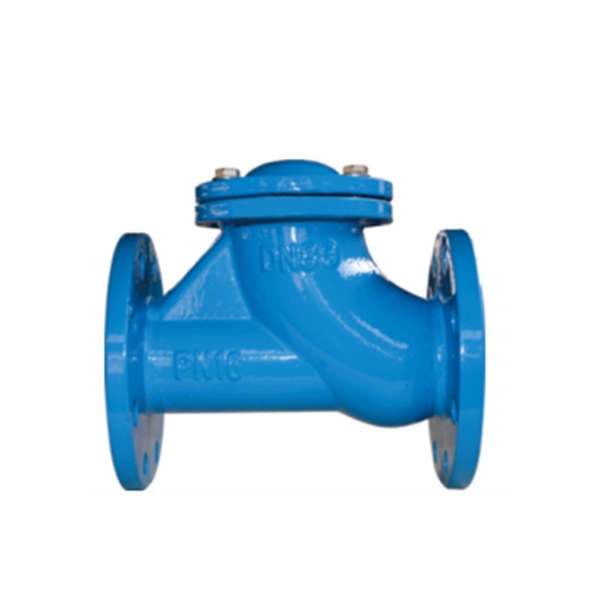

Rolling Ball Check Valve HO41X
Rolling Ball Check Valve Purpose
This product is mainly set on the pump outlet in cold water, hot water, industrial and living sewage pipe-nets to prevent the medium from back flow and more suitable for Submersible sewage pumps.
Rolling Ball Check Valve Definition and Components
Definition:
A Rolling Ball Check Valve HO41X is a specialized type of silent check valve that uses a spherical ball as the closing element. The designation indicates:
- HO41X: Chinese standard designation (GB/T 12238) for "ball type check valve"
- Rolling Ball: Features a free-moving ball that rolls in and out of seating position
- Silent Operation: Designed to prevent water hammer and noise during closure
Main Parts:
- Body: Typically cast iron, stainless steel, or bronze with Y-pattern design
- Ball: Precision sphere made of stainless steel, chrome steel, or rubber-coated metal
- Seat: Machined conical or spherical seating surface, often with elastomeric insert
- Spring: Optional compression spring to assist ball return (silent check version)
- Body Cap/Cover: Removable end cap for ball access and maintenance
- Gasket: Seals between body and cap
- Guide/Retainer: Keeps ball aligned in flow path
- Connection Ends: Threaded (NPT/BSP) or flanged connections
Role, Characteristics, and Application Scenarios of Rolling Ball Check Valve in Pipelines
Functions in Pipelines:
- Backflow Prevention: Automatically closes when flow stops or reverses
- Water Hammer Elimination: Slow, controlled closure prevents pressure surges
- Silent Operation: No "slam" or impact noise during closing
- Vertical/Horizontal Installation: Can be installed in any orientation
Operational Features:
- Low Cracking Pressure: Opens with minimal forward pressure (0.02-0.1 bar)
- Minimal Flow Restriction: Full port design with low pressure drop
- Quick Response: Rapid closure prevents reverse flow momentum
- Self-Cleaning: Ball rotation helps prevent debris accumulation
- Bubble-Tight Closure: Precision ball and seat provide zero leakage
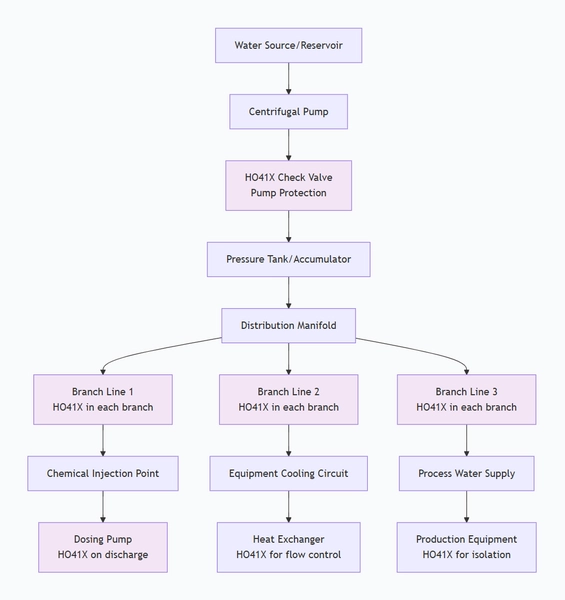
Application Scenarios:
- Pump Protection: On discharge side of centrifugal pumps
- Hydronic Systems: Heating and cooling water circuits
- Compressed Air Systems: Prevent backflow in pneumatic lines
- Chemical Injection: Metering pump discharge lines
- Irrigation Systems: Drip and sprinkler system protection
- Laboratory Equipment: Precision fluid control systems
- Medical Equipment: Sterile fluid handling systems
Scenario Diagram:
Rolling Ball Check Valve Standards: Materials, Design, and Connections
| Standard Category | Applicable Standards | Specific Requirements |
| Design Standard | GB/T 12238-2008 | Ball type check valves general specification |
| International Equivalents | API 6D, ASME B16.34, DIN 3357 | Similar international standards |
| Material Standard | Body: GB/T 12226/12227/12229 Ball: GB/T 1220 (Stainless) Seat: GB/T 21873 (Elastomers) | Material specifications |
| Connection Standards | Threaded: GB/T 7306, GB/T 12716 Flanged: GB/T 17241, GB/T 9113 | Connection specifications |
| Pressure-Temperature | GB/T 12224 | Pressure-temperature ratings |
| Testing Standard | GB/T 13927-2008 | Pressure testing requirements |
| Spring Standards | GB/T 1239, GB/T 2088 | Spring specifications if applicable |
Pressure Ratings:
- Standard: PN16, PN25, PN40
- High Pressure: PN63, PN100 available
- Working pressure up to 40 bar (580 psi)
Size Range:
- Small bore: DN15 to DN50 (½" to 2") most common
- Larger sizes: Up to DN150 (6") available
- Miniature versions: ¼", ⅜" for instrumentation
How to Select Rolling Ball Check Valve
Water supply valve types Technical Specification Checklist:
Critical Parameters:
- Size: DN [15/20/25/32/40/50 etc.]
- Pressure Rating: PN16/PN25/PN40
- Connection Type: Threaded (NPT/BSP), Flanged, Union ends
- Body Material: Cast Iron/Brass/Stainless Steel 304/316
- Ball Material: Stainless Steel 304/316/Chrome Steel/Ceramic
- Seat Material: EPDM/NBR/Viton/PTFE/Metal
- Spring Option: With/without spring (specify spring material)
- Temperature Range: Standard: -20°C to 120°C
Performance Requirements:
- Cracking Pressure: Specify exact value (e.g., 0.05 bar)
- Flow Coefficient: Cv/Kv value required
- Leakage Class: Class IV/Class VI/Zero leakage
- Maximum Working Temperature: Based on seat material
- Flow Direction: Horizontal/Vertical/Any position
Check Valve for Water Certification Requirements:
- GB/T 12238 compliance certificate
- ISO 5208 leakage test report
- Material certificates (EN 10204 2.1/3.1)
- CE/PED for European market
- UL/FM for fire protection applications
- 3.1B material certificates for pressure equipment
Supplier Evaluation Matrix:
| Criteria | Weight | Evaluation Points |
| Technical Capability | 30% | Ball precision machining, spring manufacturing, testing facilities |
| Quality System | 25% | ISO 9001, material traceability, process control |
| Experience | 20% | Years in production, similar project references |
| Pricing | 15% | Competitive pricing, payment terms, Incoterms |
| Delivery | 10% | Lead time, on-time delivery history |
Commercial Considerations:
Price Brackets:
- DN15-25: $20-80 per piece
- DN32-50: $50-200 per piece
- Stainless steel versions: 2-3× carbon steel price
Minimum Order Quantity: Typically 10-50 pieces
- Delivery Time: 30 days for standard, 45-60 days for special materials
- Payment Terms: 30% deposit, 70% before shipment
- Warranty: 18-24 months from shipment date
Pre-Shipment Inspection for Export Rolling Ball Check Valve and Key Considerations
Inspection Checklist:
| Inspection Item | Method | Acceptance Criteria | Tools Required |
| Visual Inspection | Visual | No defects, smooth surfaces | Magnifying glass |
| Dimension Check | Measurement | Within GB/T 12238 tolerances | Calipers, thread gauge |
| Ball Diameter | Micrometer | ±0.01mm tolerance | Micrometer |
| Surface Finish | Visual/Comparator | Ra ≤ 0.8μm for ball, ≤ 3.2μm for seat | Surface comparator |
| Spring Force | Spring tester | Within ±10% of specification | Force gauge |
| Material Verification | PMI gun/Spark test | Correct material grade | PMI analyzer |
| Markings | Visual | Clear stamping: DN, PN, material, flow arrow | -- |
| Weight | Scale | Within 3% of specification | Digital scale |
Specialized Tests:
- Cracking Pressure Test:
Test Setup:
- Valve installed in test bench
- Pressure gauge with 0.01 bar resolution
- Controlled flow source
Procedure:
- Gradually increase upstream pressure
- Record pressure when first flow detected downstream
- Repeat 3 times, take average
Acceptance:
- Within ±0.02 bar of specified value
- Consistent across multiple tests
- Flow Coefficient Test (Cv/Kv):
Test Method: ISO 5208 or equivalent
Parameters:
- Test medium: Water at 20°C
- Pressure drop: 1 bar
- Flow measurement: Calibrated flow meter
Calculation:
Cv = Q × √(SG/ΔP)
Where: Q = flow rate, SG = specific gravity, ΔP = pressure drop
Acceptance:
- Within ±10% of catalog value
- Cycle Life Test (Sampling):
Test Parameters:
- Medium: Clean water
- Pressure: Rated working pressure
- Cycles: 10,000 open-close cycles
- Frequency: 10-20 cycles per minute
Post-Test Inspection:
- Ball surface inspection (no scratches)
- Seat wear measurement (<0.1mm)
- Leakage test (must still meet Class IV)
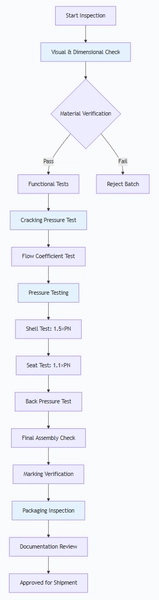
Pressure Testing Protocol:
Packaging Specifications:
Level 1: Individual Valve Protection
Small Valves (DN15-25):
- Plastic bag with anti-corrosion paper
- Foam end caps for threaded connections
- Individual cardboard box with product label
Medium Valves (DN32-50):
- Bubble wrap or foam wrap
- Plastic caps on all openings
- Corrugated box with internal partitions
Large Valves (DN65+):
- Wooden frame with foam cushioning
- Plastic shrink wrap
- Desiccant bag inside
Level 2: Export Packaging
Packing Groups:
- Group by size and material
- Maximum 20kg per inner box
- Stacking limit: 5 boxes high
Crate Requirements:
- 12mm plywood minimum
- Steel strapping every 300mm
- Forklift pockets for >50kg crates
- Humidity indicator in each crate
Labeling:
- "FRAGILE - PRECISION INSTRUMENT"
- "KEEP DRY" with umbrella symbol
- "THIS SIDE UP" arrows
- Net/Gross weight in kg
- Valve quantity and sizes
Critical Precautions:
- Ball Handling and Protection:
- Never touch precision ball with bare hands
- Store in clean, lint-free environment
- Protect from dust and contamination
- Inspect for surface defects under magnification
- Spring Protection:
- Prevent over-compression during storage
- Keep away from magnetic fields
- Protect from corrosion
- Verify spring rate before installation
- Shipping Considerations:
Temperature Control:
- Maintain 5°C to 40°C during transit
- Avoid freezing (can damage elastomers)
- Prevent condensation inside packages
Vibration Protection:
- Use vibration-damping packaging
- Secure valves to prevent movement
- Avoid stacking heavy items on top
Documentation:
- Include MSDS for special materials
- Provide installation torque specifications
- Include spring compression instructions
Common Rejection Criteria:
Material Defects:
Ball out-of-round > 0.005mm
Seat surface scratches visible to naked eye
Corrosion on stainless steel components
Incorrect material grade (verified by PMI)
Performance Failures:
Cracking pressure outside tolerance (±0.02 bar)
Leakage > 0 bubbles per minute (Class IV)
Ball sticks in open or closed position
Excessive pressure drop (>5% above catalog)
Documentation Issues:
Missing or incomplete test certificates
Incorrect material certifications
No traceability to heat/lot numbers
Manuals in incorrect language
Sampling Plan for AQL Inspection:
| Lot Size | Sample Size | AQL Major | AQL Minor |
| 2-50 | 5 | 0.65% | 1.5% |
| 51-150 | 13 | 1.0% | 2.5% |
| 151-500 | 20 | 1.5% | 4.0% |
| 501-3200 | 32 | 2.5% | 6.5% |
Final Verification Steps Before Shipping:
Container Inspection:
- Check container for leaks, damage
- Verify cleanliness (no pests, debris)
- Confirm proper ventilation
Loading Supervision:
- Witness loading process
- Verify proper securing of cargo
- Confirm temperature controls if required
Documentation Final Check:
- All certificates signed and stamped
- Packing list matches actual contents
- Shipping marks clearly visible
- Insurance coverage confirmed
Pre-Shipment Meeting:
- Review all inspection reports
- Address any open issues
- Confirm shipping schedule
- Establish communication protocol during transit
By implementing this comprehensive inspection protocol, buyers can ensure HO41X Rolling Ball Check Valves meet the highest quality standards, perform reliably in critical applications, and comply with international regulations for pressure equipment.
Rolling Ball Check Valve Main dimensions(mm)
| DN | 50 | 65 | 80 | 100 | 150 | 200 | 250 | 300 | |
| L | 219 | 222 | 256 | 282 | 353 | 432 | 495 | 550 | |
| D | PN10 | 185 | 185 | 200 | 220 | 280 | 335 | 395 | 445 |
| PN16 | 185 | 185 | 200 | 220 | 280 | 335 | 405 | 460 | |
| D1 | PN10 | 145 | 145 | 160 | 180 | 240 | 295 | 350 | 400 |
| PN16 | 145 | 145 | 160 | 180 | 240 | 295 | 355 | 410 | |
| n-Фd | PN10 | 4-19 | 4-19 | 8-19 | 8-19 | 8-19 | 8-23 | 12-23 | 12-23 |
| PN16 | 4-19 | 4-19 | 8-19 | 8-19 | 8-19 | 12-23 | 12-26 | 16-26 | |
Note:1. Other specifications and flange standards are available upon request.
- Design and specifications are subject to change without prior notice.