







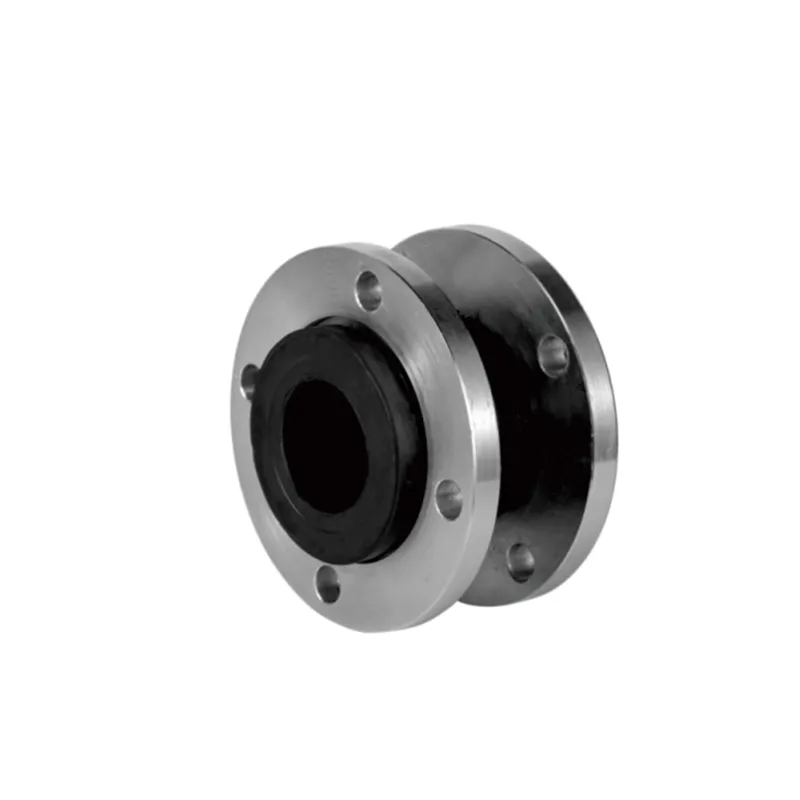

Single Sphere Flanged Rubber Expansion Joint KDTF 2
Single Sphere Flanged Rubber Expansion Joint Purpose
Used to connect the water supply and drainage, air pipelines in building, petroleum and chemical etc, industries and able to eliminate the pipeline shock, compensate the pipeline telescopic amount to make installation easier.
Single Sphere Flanged Rubber Expansion Joint Definition and Components
What is a Single Sphere Flanged Rubber Expansion Joint KDTF 2 and its main parts?
A Single Sphere Flanged Rubber Expansion Joint KDTF 2 is a flexible connector used in piping systems. It features a single spherical rubber arch (or convolution) with integral flanges at both ends. This design is engineered to absorb movement, dampen vibration, and compensate for misalignment in a more compact form factor compared to twin-sphere designs. The "KDTF 2" model designation typically refers to a specific series with flanged connections.
Single Sphere Flanged Rubber Expansion Joint Main Parts:
- Single Rubber Arch (Sphere): The primary flexible element, a single spherical bulge made of elastomer (e.g., EPDM, NBR, Natural Rubber).
- Reinforcement Ply: Layers of high-strength fabric (polyester, nylon) or steel cord embedded within the rubber to provide pressure capability and prevent over-extension.
- Flanges: Integral, molded steel flanges (usually carbon steel with a protective coating) at each end for bolted connection to the pipeline.
- Inner Liner: A smooth, continuous rubber surface inside the joint compatible with the fluid medium.
- External Cover: A protective rubber layer resistant to weathering, ozone, and abrasion.
Role, Characteristics, and Application Scenarios of Single Sphere Flanged Rubber Expansion Joint in Pipelines
Functions, Operational Features, Usage Scenarios, and Scenario Diagram
Functions: To absorb pipeline movement (axial, lateral, angular), isolate vibration and noise, compensate for minor installation misalignment, and relieve system stress.
Fire Protection Water Supply Operational Features:
- Multi-Directional Flexibility: Capable of absorbing compression, extension, lateral shift, and angular rotation, though with generally lower movement capacity per unit length than a twin-sphere joint.
- Compact Design: Requires less installation space than a twin-sphere joint.
- Pressure Resilience: Maintains integrity under system pressure due to internal reinforcement.
- Electrical Isolation: Breaks galvanic corrosion pathways between dissimilar metals.
- Usage Scenarios: Applied in systems where space is constrained or movement requirements are moderate.
- Building Services: HVAC piping for chillers, pumps, and air handlers.
- Water Treatment: Inlet and outlet of pumps and filters.
- Industrial Piping: Connections to compressors, generators, and other equipment.
- Marine Applications: Engine cooling lines, shipboard piping.
- Compensating for Thermal Expansion in shorter pipe runs.
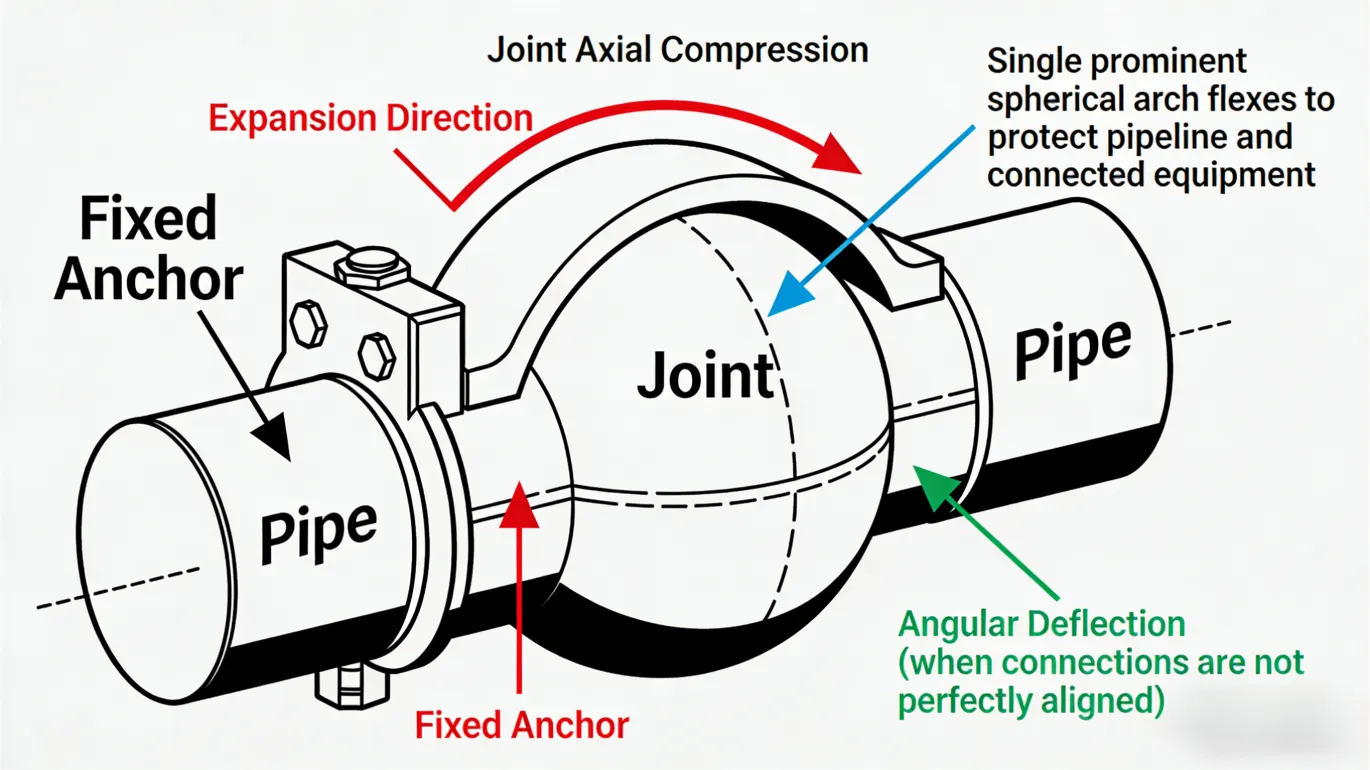
Single Sphere Flanged Rubber Expansion Joint Standards: Materials, Design, and Connections
Material, Design, and Connection Standards
Material Standards:
- Elastomer: EPDM (for hot water, steam, outdoor use), NBR (for oils, fuels), CR (Neoprene for general purpose, fire resistance).
- Reinforcement: High-tensile textile cord or steel wire mesh.
- Flanges: Carbon steel (ASTM A36) with rubber covering or coated (galvanized, painted).
- Design & Performance Standards: Commonly manufactured to meet performance guidelines similar to EJMA (Expansion Joint Manufacturers Association) standards and AWWA C219 for waterworks. Specific pressure/temperature/movement ratings are per manufacturer's specifications based on design.
- Connection Standards: The integral flanges conform to standard dimensions for bolting:
- ASME B16.5 (Class 125/150)
- EN 1092-1 (DIN) (PN10/PN16)
Flange drilling, diameter, and facing match the ordered specification.
How to Select Single Sphere Flanged Rubber Expansion Joint
How to Purchase Flexible Rubber Joint
- Define Application Requirements: Specify pipe size (DN/NPS), system pressure and temperature, media (chemical compatibility), the type and amount of movement to be absorbed (axial, lateral, angular), and available installation space.
- Select Suppliers: Source from specialized manufacturers of rubber expansion joints. Evaluate their experience, technical support, and quality certifications (ISO 9001).
- Request Technical Submission: Provide requirements and request a detailed quotation including: material specification sheet, movement capacity charts, pressure rating, dimensional drawings, and certification availability.
- Compare and Order: Assess proposals for technical suitability, price, and lead time. Ensure the purchase order clearly states: Model (KDTF 2), Size, Pressure Rating, Elastomer Type, Flange Standard, and any special testing or documentation needs
Pre-Shipment Inspection for Export Single Sphere Flanged Rubber Expansion Joint and Key Considerations
Pre-Export Inspection and Precautions
Inspection Protocol:
- Visual & Physical Check: Inspect for surface imperfections, cracks, or poor bonding between rubber and metal flanges. Check for proper shape and absence of twisting.
- Dimensional Verification: Confirm overall length, flange outside diameter, bolt hole circle (B.C.), and hole size against the provided drawing.
- Marking & Documentation: Verify permanent markings (size, pressure, model) and review material certificates for rubber and flange.
- Packaging Inspection: Ensure the joint is packed to prevent deformation—often with internal bracing or by mounting on a wooden skid/pallet. Flange faces must be protected.
Precautions:
- Prevent Deformation: Do not stack heavy items on top. Store and ship in a neutral, non-stretched, non-compressed state.
- Protect Flanges: Use wooden or plastic covers bolted onto flange faces to prevent damage to sealing surfaces and bolt holes.
- Environmental Protection: Protect from direct sunlight, ozone sources, and extreme temperatures during storage/transit.
- Complete Shipment Package: Ensure clear shipping marks, handling symbols ("Flexible - Do Not Bend"), gross weight, and a waterproof envelope containing all technical documents inside the shipment.
Single Sphere Flanged Rubber Expansion Joint Main dimensions(mm)
| DN | 50 | 65 | 80 | 100 | 125 | 150 | 200 | 250 | 300 | |
| L | 105 | 115 | 135 | 150 | 165 | 180 | 210 | 230 | 245 | |
| D | 165 | 185 | 200 | 220 | 250 | 280 | 340 | 405 | 460 | |
| D1 | 125 | 145 | 160 | 180 | 210 | 240 | 295 | 355 | 410 | |
| b | 15 | 15 | 17 | 18 | 20 | 20 | 22 | 24 | 24 | |
| n-Фd | 4-18 | 4-18 | 8-18 | 8-18 | 8-18 | 8-22 | 12-22 | 12-26 | 12-26 | |
| Axial displacement | Extension | 7 | 7 | 8 | 10 | 12 | 12 | 16 | 16 | 16 |
| Canprassion | 10 | 13 | 15 | 19 | 19 | 20 | 25 | 25 | 25 | |
| Lateral displacement | 10 | 11 | 12 | 13 | 13 | 14 | 22 | 22 | 22 | |
| Deflection angle | 15 | 15 | 15 | 15 | 15 | 15 | 10 | 10 | 10 | |
Note:1. Other specifications and flange standards are available upon request.
- Design and specifications are subject to change without prior notice.