







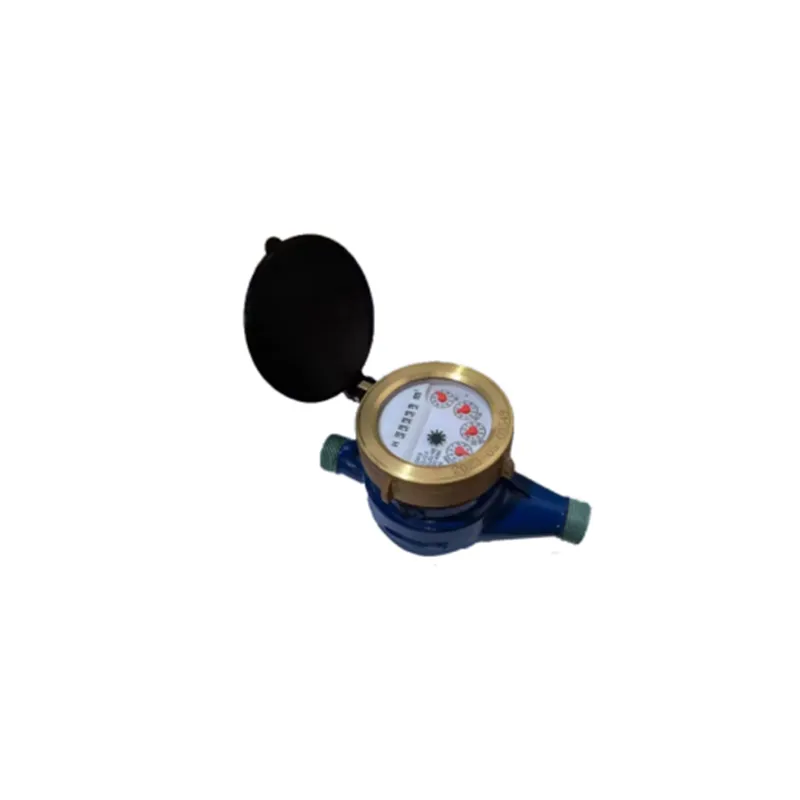

Water Meter/Screwed End BSPT
Water Meter/Screwed End BSPT Definition and Components
What is a Water Meter/Screwed End BSPT PN16 and its main parts?
A Water Meter with Screwed End BSPT PN16 is a water volume measurement device designed for smaller pipeline diameters. It features British Standard Pipe Taper (BSPT) threaded connections at both ends, allowing for direct screw-in installation without flanges. The PN16 rating indicates it is designed for a maximum working pressure of 16 bar. It is compact, cost-effective, and widely used for end-user billing and monitoring.
Water Meter/Screwed End BSPT Main Parts:
- Meter Body/Housing: The outer casing, typically made of bronze, brass, or cast iron, which houses the internal mechanism and features the male or female BSPT threads.
- Measuring Chamber/Cartridge: The core unit where flow measurement occurs. Common types include:
- Single-jet or Multi-jet Chamber: For velocity-based measurement.
- Volumetric Chamber: For positive displacement measurement (e.g., oscillating piston, nutating disc).
- Impeller/Turbine or Piston/Disc: The moving element driven by water flow.
- Magnetic Coupling or Gear Train: Transmits the motion from the wet chamber to the dry register without direct contact, ensuring a watertight seal.
- Register (Counter/Indicator): Displays the totalized water volume, usually in cubic meters (m³) or liters. Can be mechanical (number wheels) or electronic (LCD).
- Threaded End Connections: Integral male (external) or female (internal) BSPT threads, sized according to standards (e.g., ½", ¾", 1").
- Strainer/Sieve (Optional): Often integrated at the inlet to protect the mechanism from debris.
Role, Characteristics, and Application Scenarios of Water Meter/Screwed End BSPT in Pipelines
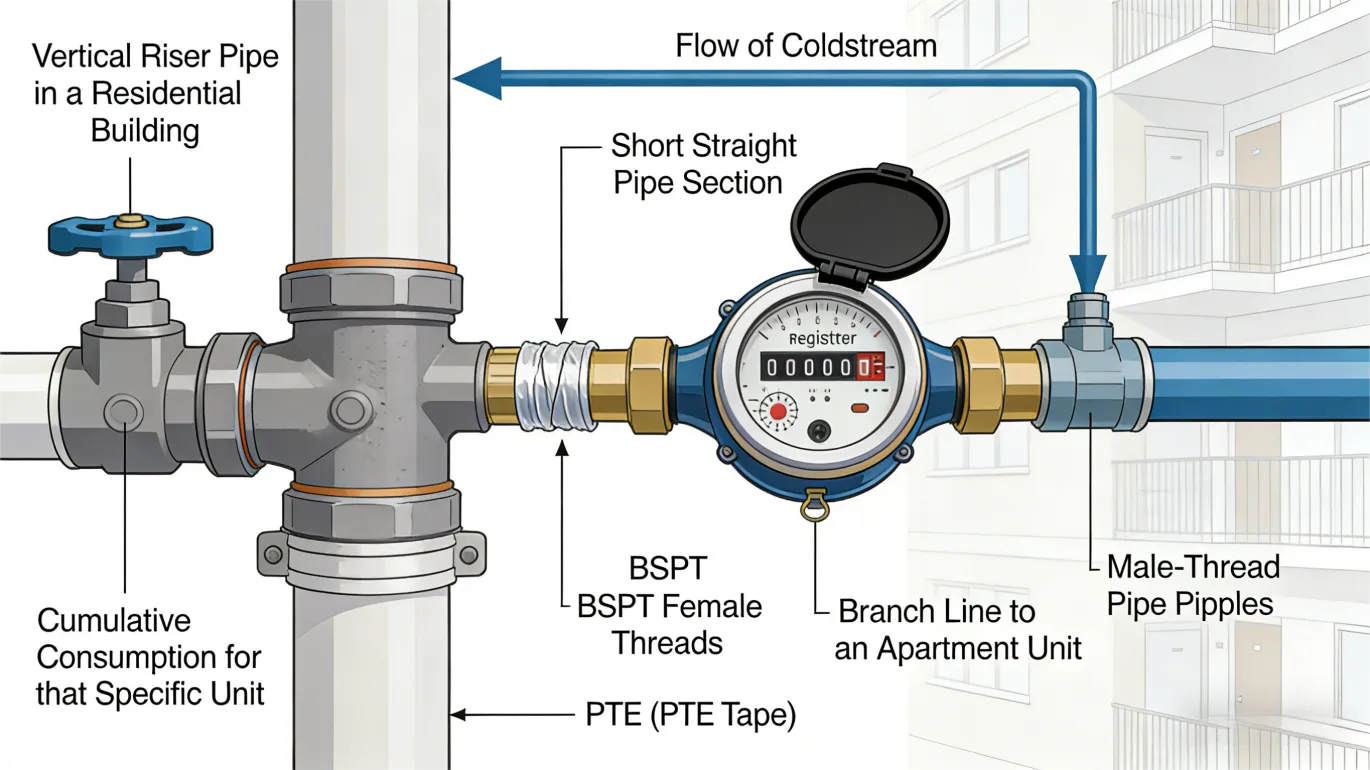
Functions, Operational Features, Usage Scenarios, and Scenario Diagram
Functions: To accurately measure, indicate, and totalize the volume of cold (or hot) potable water passing through a pipeline for billing, consumption monitoring, and leak detection.
Operational Features:
- Direct Threaded Connection: Simple installation using pipe wrenches and sealant tape/paste.
- Low Flow Sensitivity: Good accuracy at both low and high flow rates within its specified metering range (Q1 to Q4).
- Low Pressure Loss: Designed to minimize restriction to flow.
- Bidirectional Sealing (often): The threads and body seal can typically handle pressure from either direction.
- Dry Dial/Dry Reader: The register is isolated from the water, preventing fogging and allowing for optional pulse output connections.
- Usage Scenarios:
- Residential Apartment/Individual Unit Metering.
- Small Commercial Establishments (shops, restaurants, offices).
- Submetering within a larger building or complex.
- Industrial Process Lines with small water supply lines.
- Agricultural or Garden Watering Points.
Water Meter/Screwed End BSPT Standards: Materials, Design, and Connections
Material, Design, and Connection Standards
Water Supply Valves Material Standards:
- Body: CW617N (Lead-free brass), Bronze (C83600/C84400), or Cast Iron.
- Internal Mechanism: Plastics (Polysulfone, Noryl), Stainless Steel, Ceramic (for bearings).
- Register Window: Polycarbonate or glass.
Design Standards:
- Metrological: ISO 4064 (Water meters for cold potable water and hot water). Key parameters include accuracy class (e.g., Class 2), flow rates (Q1, Q2, Q3, Q4), and maximum permissible errors (MPEs).
- Legal Metrology: For EU markets, compliance with the Measuring Instruments Directive (MID) and an active Type Examination Certificate are mandatory. OIML R49 is an international recommendation.
- Pressure Rating: PN16 per EN 12201 or similar standards.
- Connection Standards:
- Thread Standard: ISO 7-1 (BS 21) for BSPT (British Standard Pipe Taper) threads. The "T" denotes tapered threads which provide a pressure-tight seal.
- Common Sizes: DN15 (½"), DN20 (¾"), DN25 (1")
How to Select Water Meter/Screwed End BSPT
How to Purchase Water Meter
Define Technical Specifications:
- Nominal Size (e.g., DN15, ½").
- Fluid Type (Cold water <30°C / Hot water >30°C, up to a specified max, e.g., 90°C).
- Required Accuracy Class (e.g., ISO 4064 Class 2).
- Flow Rate Range (Q3 - Permanent Flow Rate) suitable for the application.
- Required Certifications (MID for EU, OIML for other markets, local approvals like UKCA, NSF for potable water contact).
- Register Type (mechanical, electronic with pulse output).
- Identify Certified Suppliers: Source from manufacturers or distributors who can provide valid MID Type Examination Certificates or equivalent for the exact model. Check for ISO 9001 quality management certification.
- Request Technical Documentation: Ask for:
- Detailed datasheet with metrological characteristics (Q1-Q4 values, accuracy curves).
- Copy of the Type Approval Certificate (MID or other).
- NSF/WRAS certificate of conformity for materials in contact with drinking water (if required).
- Dimensional drawing and installation instructions.
- Evaluate and Order: Compare offers based on certification validity, technical fit, price, and warranty. Ensure the purchase order references the exact model, certification numbers, and required test documentation.
Pre-Shipment Inspection for Export Water Meter/Screwed End BSPT and Key Considerations
Pre-Export Inspection and Precautions
Inspection Protocol:
- Visual & Marking Check: Verify clean casting, no defects. Check for permanent markings: size, PN16, Q3 value, accuracy class, manufacturer, model, year, MID "M" mark and notified body number (if applicable), flow direction arrow.
- Dimensional & Thread Gauge Check: Verify thread size and taper using ring/plug gauges to ensure proper fit.
- Metrological Performance Test (SAMPLING): Perform or witness a sample test on a calibrated water test bench according to ISO 4064. Check error at a minimum of three flow points (low, medium, high). Errors must be within the MPE for its class.
- Pressure Test: Subject meters to a hydrostatic pressure test (e.g., 2.4 MPa for PN16) to check for casing or seal leakage.
- Function Test: Check that the register advances smoothly and resets to zero correctly (for new meters). Test pulse output if applicable.
- Packaging Inspection: Individual boxes should protect the register glass and threads. Threads should have protective plastic caps.
Precautions:
- Legal Sealing: Ensure the manufacturer's security seal is intact and unbroken. This is crucial for legal metrology integrity.
- Protect Threads: Caps must be secure to prevent damage that could cause leaks during installation.
- Avoid Moisture & Condensation: For electronic meters, ensure silica gel packets are in the packaging.
- Complete Documentation: Each shipment must include:
- Certificate of Conformity stating compliance with relevant directives (MID).
- Initial Verification Report (if the meter is pre-calibrated for the destination country).
- Instruction manual in the required language.
- Country-Specific Requirements: For some markets, initial verification must be performed by the destination country's metrology authority; in this case, meters are shipped without final sealing/verification. Clarify this requirement beforehand.
Water Meter/Screwed End BSPT Main dimensions(mm)
| Size (mm) | Q s Max. Flow | QP Nominal Flow | Qt Transmitional Flow | Qmin Min Flow | Min. Reading | Max. Reading |
| m'/h | L/h | M' | ||||
| 15 | 3 | 1.5 | 150 | 60 | 0.0001 | 999999 |
| 20 | 5 | 2.5 | 250 | 100 | 0.001 | 999999 |
| 25 | 7 | 3.5 | 350 | 140 | 0.0001 | 999999 |
| 40 | 20 | 10 | 1000 | 400 | 0.001 | 999999 |
a) In the lower zonefrom Qmin inclusiveup to but excluding Qt is ± 5%.
b)In the upper zone from Qt inclusive up to and including Qs is cold potable water meter + 2%.